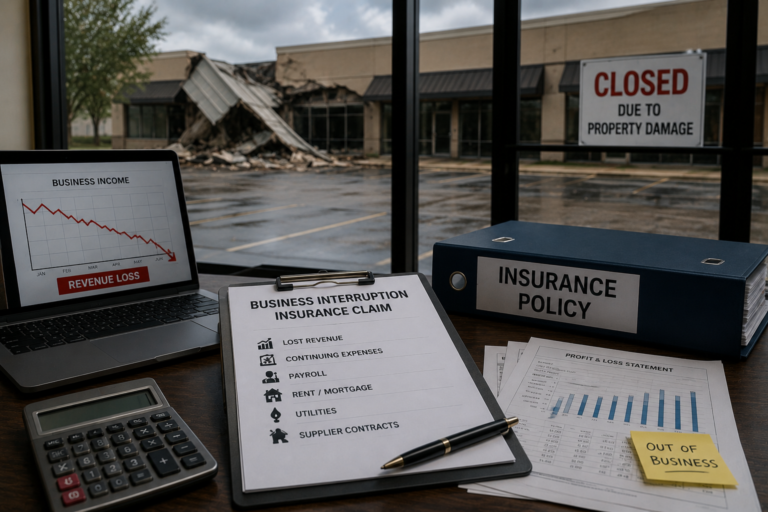
Your revenue stopped. Your rent, payroll and loan payments did not. The business income section of your property policy exists for exactly that gap — and it is one of the most under-paid sections in commercial insurance.
Business interruption coverage does not pay for damage. It pays for the money the damage cost you. That makes it an accounting question wrapped in a legal one, and it is where most policyholders leave the largest amount on the table.
What business interruption coverage actually promises
Most commercial property policies and business owner's policies contain a business income (or business
interruption) form. In its standard shape it promises to pay the actual loss of business income
you sustain because of a necessary suspension of operations, where the suspension is caused by
direct physical loss of or damage to property at the described premises from a covered cause of loss.
Three components do most of the work in that sentence, and each is a place where claims are lost:
Suspension. Many forms define this to include a slowdown, not only a complete
stop. Insurers do not always volunteer that.
Direct physical loss or damage. Two things joined by “or,” which
means they cannot mean the same thing. Loss of use and loss of functionality have both been argued
successfully under the first limb.
Period of restoration. The clock usually starts at the loss and runs until the
property should be repaired with reasonable speed — not until it actually is. Delay caused by
the insurer's own slow adjustment does not extend it, which is why early pressure matters.
The three coverages people forget to claim
Extra expense
Money spent to keep operating — temporary premises, expedited shipping, equipment rental, overtime.
It is often payable even where the income loss itself is limited, and it is frequently omitted from
first submissions entirely.
Civil authority coverage responds when a government order prohibits access to your
premises because of damage to other property nearby. It typically has its own waiting period and
its own time limit, and its own distinct trigger — which means it can pay even where the main business
income coverage does not.
Contingent business interruption covers losses caused by damage to someone else's
property: a key supplier, a manufacturer, an anchor tenant whose closure emptied the mall. If your loss
came from upstream, this is the section to read.
How the loss is calculated — and where insurers shave it
Business income is usually defined as net income (profit or loss before tax) that would have been earned,
plus continuing normal operating expenses including payroll. That second half is where disputes
live. A carrier's first calculation often:
What the insurer does
Why it understates the loss
Uses last year's revenue flat
Ignores growth trends the policy's own experience clause requires be considered
Strips out all payroll as “saved”
Key employees retained during a shutdown are a continuing expense, not a saving
Ends the period at reopening
Many forms include an extended period of indemnity for the ramp back to normal trading
Treats a partial reopening as full recovery
A slowdown remains a suspension under most definitions
Deducts government relief received
Rarely supported by the policy language unless a specific provision says so
We engage a forensic accountant early, before the insurer's number has been on the file long enough to
become the reference point. A properly built loss model, with the assumptions documented, changes the
conversation more reliably than argument does.
The exclusions that come up
Virus and communicable disease exclusions were added to many forms after 2003 and became near-universal
after 2020 — but they are not in every policy, they are not always worded the same way, and they do not
reach every fact pattern. Beyond those, expect to see arguments about wear and tear, faulty workmanship,
ordinance or law, and the anti-concurrent-causation clause. Each is read narrowly, and the insurer bears
the burden of establishing that one applies.
What to do while the claim is open
Ask in writing for a complete certified copy of the policy including all endorsements.
Keep a claims chronology — every call, every name, every promise, dated.
Do not sign a sworn proof of loss with a number you have not had built properly.
Mitigate, and keep the receipts. Reasonable mitigation costs are frequently reimbursable.
Questions
Business Interruption Claims — frequently asked
Usually not. Most business income forms define “suspension” to include a slowdown as well as a cessation. If you traded at 30% of normal, that is a 70% suspension for these purposes, subject to how your particular form is worded.
Then look at civil authority and, if a supplier or anchor tenant is involved, contingent business interruption. Both are triggered by damage to property other than yours, and both are regularly overlooked in first submissions.
From the date of loss until the date the damaged property should be repaired, rebuilt or replaced with reasonable speed and similar quality — not the date it actually happens. Many forms then add an extended period of indemnity of 30, 60 or 90 days to cover the ramp back to normal trading. Check both.
Usually yes. Insurers sometimes argue relief funds offset the loss, but that argument needs to be grounded in specific policy language, and often is not. Bring the documentation and let us read the form.
Related reading
Guides that go deeper
Business income
Civil authority coverage in Colorado: when a government order triggers your business income policy
A government order closed you down and the damage was to someone else's property. That is the exact scenario civil authority coverage was written for — and the exact scenario insurers fight hardest.