Of all the documents in a property insurance claim, the sworn proof of loss carries the most
risk per page. It is short, it looks administrative, and it is signed under oath.
What a proof of loss is
A proof of loss is a formal, sworn statement in which the policyholder sets out the loss being claimed: what
happened, when, what was damaged, and how much is claimed. It is a condition of most first-party property
policies, which means the insurer is generally entitled to demand one and your obligation to provide it is
part of the contract.
It is also, from the insurer's perspective, a way to fix your position. Whatever number appears on that form
becomes the reference point for the rest of the claim, and it was sworn to.
What the form asks for
| Item | What it means in practice |
|---|
| Time and origin of the loss | Date and cause. Be accurate; if the cause is disputed, describe the event rather than characterising it. |
| Interest of the insured and others | Ownership, and anyone else with an interest — mortgagee, landlord, lienholder. |
| Other insurance | Any other policy that might respond. Omitting one that exists is a serious problem. |
| Changes in the property | Alterations, occupancy changes, vacancy — these interact with policy conditions. |
| Amount claimed | The figure. This is the line that matters most. |
| Supporting documentation | Estimates, inventories, accounting records, photographs. |
The deadline, and how to move it
Most policies require the sworn proof of loss within sixty days of the insurer's request. Some say thirty.
The clock generally starts when the insurer requests it, not at the date of loss — but read your own
condition, because the wording varies.
Sixty days is often not enough time to have a large commercial loss properly quantified. The answer is not
to miss the deadline; it is to ask for an extension in writing, before the deadline, stating
why and proposing a date. Insurers grant these routinely. What they will not grant is an extension requested
after the date has passed.
Put everything in writing
A verbal assurance from an adjuster that “we are not worried about the sixty days” is worth
nothing if that adjuster leaves the file. Confirm every extension by email and keep the reply.
The three ways it goes wrong
- Understating the loss. The most common and most damaging error. Policyholders submit
the adjuster's figure, or a contractor's early estimate, because it is the only number they have. Every
later attempt to increase it then has to explain the discrepancy in a sworn document.
- Guessing. Round numbers with no support invite challenge and undermine credibility on
everything else in the file.
- Overstating. Far rarer, and far more dangerous. A materially inflated sworn figure can
trigger the fraud or concealment condition and void the entire claim. Every number must be supportable.
What happens if you do not file one
Failing to submit a demanded proof of loss is a breach of a policy condition, and insurers do deny claims on
that basis. Colorado law generally requires an insurer relying on the policyholder's breach of a notice or
cooperation condition to show that it was actually prejudiced by the breach — a real
burden that is frequently not met where the insurer had the information anyway.
That is a defence, not a plan. Comply with the condition, request an extension if you need one, and keep the
prejudice argument in reserve.
How to complete one safely
- Build the number before you fill in the form. Independent estimate for property, forensic
accounting for income loss. Not the adjuster's figure.
- Attach the support. Reference the estimate or report by date and attach it. The sworn
statement then rests on identified evidence rather than assertion.
- State that the figure is based on information available to date and that the loss
continues to be quantified. Most forms allow a qualification; use it accurately, not as a hedge for a
number you have not tried to establish.
- Reserve the right to supplement. Say so expressly, in the document.
- Do not release anything. A proof of loss is a statement of claim, not a settlement. If
the form you were sent includes release language, that is a different document and should be treated as one.
- Have it read before you sign it. This is a fifteen-minute review that regularly changes
the outcome of a claim.
Documenting contents and inventory
Where the claim includes contents, stock or equipment, the proof of loss is only as good as the schedule
behind it. Insurers reject contents claims less often than they simply discount them into insignificance,
and the reason is almost always the quality of the list.
| Column | Why the adjuster needs it |
|---|
| Item description, make and model | Allows a like-for-like replacement search |
| Quantity | Obvious, and constantly omitted |
| Age or purchase date | Drives depreciation; guessing high costs you money |
| Original cost, with a source | An invoice beats a recollection every time |
| Replacement cost today, with a source | A current listing or quotation, printed and dated |
| Condition before the loss | Pre-empts a blanket depreciation assumption |
| Photograph reference | Ties the line to evidence |
Where records were destroyed with the property, reconstruct: bank and card statements, supplier
purchase histories, accounting fixed-asset registers, prior insurance schedules, even dated photographs of
the premises taken for other reasons. Reconstruction is normal and expected. An unsupported round number
is not.
The income side of the number
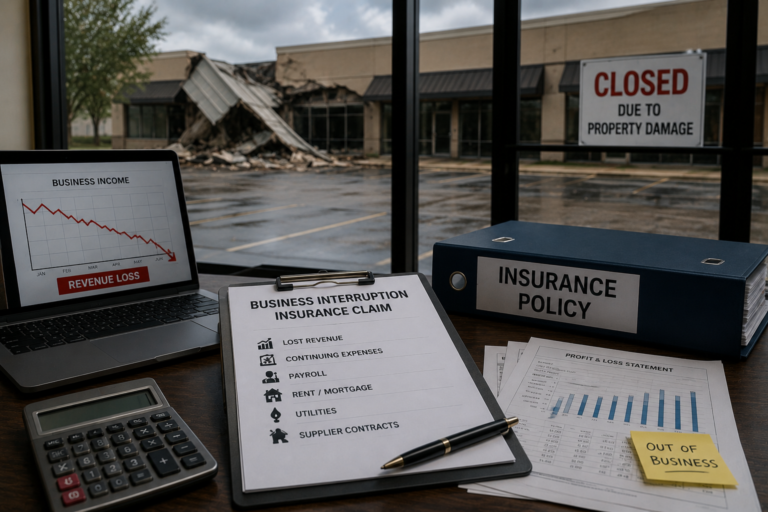
Business income losses are the part of a proof of loss most often filled in with a placeholder, because
the real figure takes weeks to build. That placeholder then becomes the sworn number.
A defensible income figure rests on four inputs:
- Historic performance — typically three years of monthly P&Ls, plus the same
months in prior years to capture seasonality.
- A projection of what would have happened but for the loss, reflecting trend and any
known changes (a contract signed, a location opened, a competitor closed).
- Actual results during the interruption, so the shortfall is a subtraction rather than
an estimate.
- Continuing expenses, separated carefully from expenses that genuinely stopped.
Retained payroll is the line most often wrongly excluded.
If the sixty days will not stretch to that work, ask for the extension in writing rather than swearing to
a number you cannot defend.
A realistic sixty-day plan
- Days 1–3. Read the condition. Diary the deadline. Confirm in writing what the
insurer is requesting and on what form.
- Days 3–10. Request the complete certified policy if you do not have it. Engage
an independent estimator and, for income losses, a forensic accountant.
- Days 10–25. Assemble the supporting documentation: inventories, invoices,
accounting records, photographs, expert reports.
- Day 25. Honest checkpoint. If the number will not be ready, request the extension now,
in writing, with a proposed date — not on day fifty-eight.
- Days 25–50. Finalise the figures. Reconcile the estimate and the accounting so
they tell one consistent story.
- Days 50–55. Draft the proof of loss, attach the support, include the
based-on-current-information qualification and the express reservation to supplement.
- Days 55–58. Have it reviewed before it is sworn. Submit with proof of delivery.
Keep a copy of exactly what you sent
Including the attachments, in the order they were attached, with the transmission receipt. Disputes
about what was submitted and when are common, tedious, and entirely avoidable.
The examination under oath
Alongside the proof of loss, most policies allow the insurer to require an examination under oath — a
formal, transcribed, sworn examination of the policyholder, usually conducted by the insurer's lawyer.
It is not a deposition and it is not adversarial in form, but it is conducted by a lawyer whose client
benefits from inconsistency. You are entitled to be represented. Prepare by reviewing the documents you have
produced, answer only the question asked, and say “I do not recall” when that is true —
because guessing at a date and being wrong is how credibility is lost.
Supplemental proofs of loss
Losses grow as repairs open up concealed damage. A supplemental proof of loss updates the claim, and it is
entirely proper — provided the original was framed as based on then-available information and expressly
reserved the right to supplement.
This is the strongest practical reason to get the wording right the first time. A well-drafted original
proof of loss makes a later supplement routine. A bare number, sworn without qualification, makes the same
supplement look like a change of story.
One sentence to remember
The proof of loss is the only document in the claim where you swear to a number. Treat the fifteen minutes
before you sign it as the most valuable fifteen minutes in the file.

 Business income